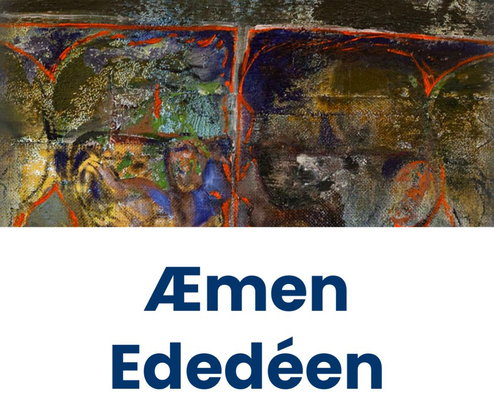
Æmen Ededéen (Joshua Hagler) lived and worked in San Francisco and then Los Angeles for fifteen years before moving to Roswell, New Mexico in 2018 as a grant recipient of the year-long Roswell Artist in Residence Program. Ededéen and his wife, the artist Maja Ruznic, now live and work in Roswell, NM. Ededéen was born at Mountain Home Air Force Base in Idaho in 1979 and is a first-generation college graduate with a visual communications degree from the University of Arizona in Tucson. Self-directed research and travel has underpinned his career and is essential to how the artist integrates creative influences with his life experience.
Æmen Ededéen (Joshua Hagler) is a 2020 Hopper Prize Finalist. 2018 saw two museum shows at the Brand Library and Art Center in Los Angeles and the Roswell Museum and Art Center in New Mexico entitled The River Lethe and Love Letters to the Poorly Regarded respectively. 2019 marked his first U.K. solo exhibition entitled Chimera, at Unit London. The artist’s second solo exhibition with Unit London, The Living Circle Us, was curated by art historian, David Anfam, and was accompanied by the artist’s debut monograph, This is The Picture. He has exhibited paintings, sculpture, video, and animation in galleries and museums in North and South America, Europe, and Australia including a long list of solo exhibitions. Hagler has completed residencies abroad in France, Italy and Norway. Reviews and features about the work, as well as his own poems and essays, have appeared in a variety of publications and media outlets in the U.S. and other parts of the world, including GQ Magazine and Italian Vogue.
Joshua Hagler | FOCUS: Joshua Hagler
February 15 - March 23, 2024
Joshua Hagler | FOCUS: Joshua Hagler
February 15 - March 23, 2024
Joshua Hagler | FOCUS: Joshua Hagler
February 15 - March 23, 2024
Joshua Hagler | FOCUS: Joshua Hagler
February 15 - March 23, 2024
Joshua Hagler | Drawing in the Dark
April 3 – May 29, 2021
Joshua Hagler | Drawing in the Dark
April 3 – May 29, 2021
Joshua Hagler | Drawing in the Dark
April 3 – May 29, 2021
Joshua Hagler | Drawing in the Dark
April 3 – May 29, 2021
Joshua Hagler | Drawing in the Dark
April 3 – May 29, 2021
Installation view: Abandoned School, 2020, New Mexico. Image courtesy of Joshua Hagler.
The Glass Dream Game is a divination game I developed in 2024, and practice on a daily basis. The idea came to me after reading Hermann Hesse's 1943 Nobel-Prize-Winning novel The Glass Bead Game. But the Glass Dream Game's underlying structure is ultimately owed to I Ching (The Book of Changes), an ancient Chinese divination system. The Game begins through a bibliomantic process selecting six books, by chance, from my private library of about 1,000 books. One page in each of these books is selected through the same chance process, resulting in a Hexagram. From these six pages, I take notes and makes sketches, looking for connections and noting any synchronicites emerging from the Hexagram. This process is called a Trial. Using the notes and sketches from the Trials, I compose a Dream in Movements, written passages connecting the elements across a Hexagram. From the Dream comes the Vision, a painting or object, not about the Dream, but in some way informed by it. Through the Hexagrams, Dreams, Visions, and Trials, an extensive network of relationships begin to emerge.
Underlying my interest in Hesse and I Ching is my personal involvement in Taoist practice and Jungian dream analysis.
Uncanny synchronicities between texts often have intense and surprising personal significance. I understand myself and my library to be entangled in an ongoing collaboration through which the Unconscious reveals Itself.
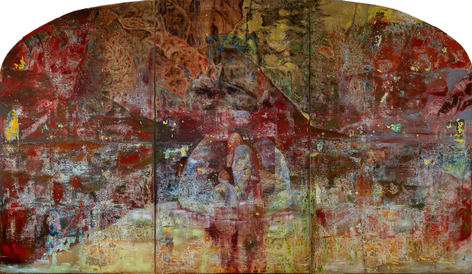
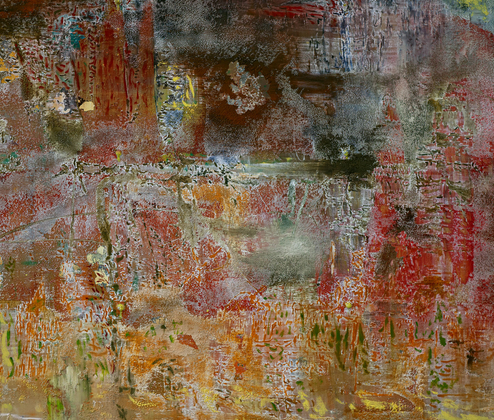
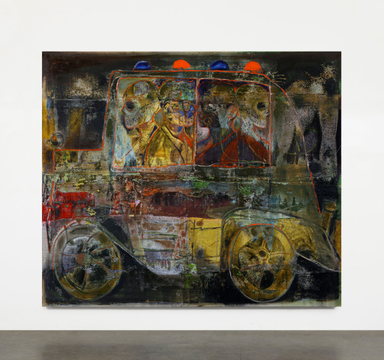
This approach aligns well with my longtime approach to painting. Any single painting I've made over the past decade or so, and any shown here, has perhaps four or five different paintings beneath it. Each layer I add to the work is done on temporary substrates that stick but don't bind to various areas of the surface. Sometimes some imagery remains in the final work. Other times, it appears to the viewer as non-representational or abstract. Different viewers tend to focus on different aspects or passages in a work, and therefore seem to have highly individualized encounters. Painting, for me, is a kind of iterative unconvering toward ever-deepening memory and mystery. I like believing that painting is to do with awakening, that it can be one valuable aspect of a larger contemplative or devotional practice.